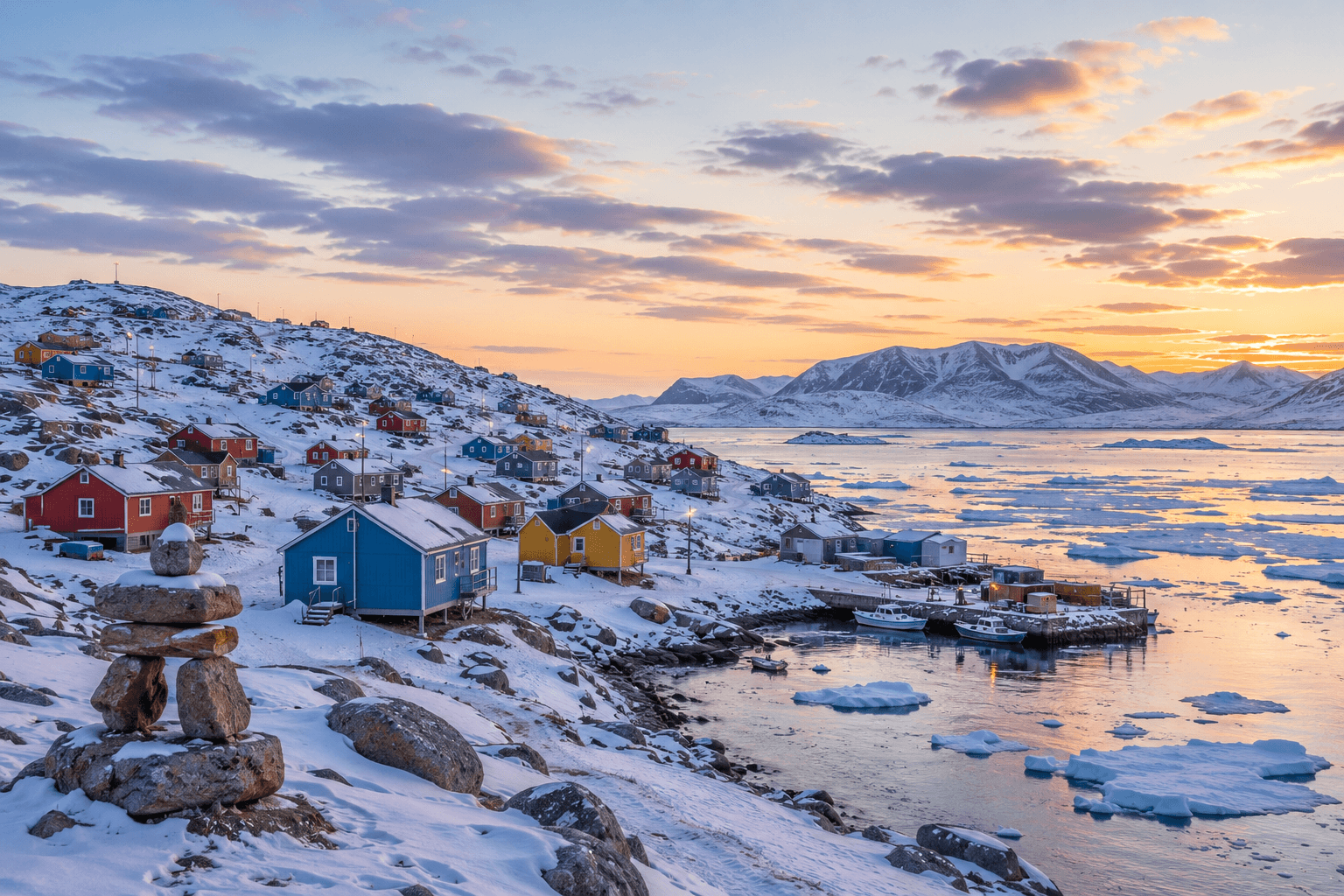
Nunavut is Canada's youngest and largest territory — a fifth of the country's landmass, home mostly to Inuit communities scattered across an Arctic archipelago.
Capital
Iqaluit
Largest community
Iqaluit
Established
1999
Population
≈ 40K
Area
2,093,190 km²
Territorial flower
Purple Saxifrage
Dispatch
Nunavut is Canada's youngest and largest territory — a fifth of the country's landmass, home mostly to Inuit communities scattered across an Arctic archipelago. Iqaluit is the capital; the rest is tundra, ice, and a way of life shaped by the land.
No. 01 · The land
The Arctic heart
Nunavut spans the mainland Arctic and thousands of islands reaching toward the North Pole. No roads connect communities — travel is by plane, boat, or snowmobile. Wildlife includes polar bears, narwhals, and caribou herds that outnumber people.
No. 02 · The people
Inuit Nunangat
Inuit have thrived in the Arctic for millennia. Nunavut was created through the largest Indigenous land claim in Canadian history. Inuktitut is the dominant language. Art, throat singing, and traditional knowledge remain central to daily life.
No. 03 · A small ritual
Standing with an inukshuk
Find a stone marker on a hilltop — built as a guide for travellers. Look north. The land goes on until ice meets sky. You are at the top of the world.
If you go
Four small detours
04 / 04
01
Iqaluit
Arctic capital with Inuit art, culture, and a frontier energy.
02
Auyuittuq National Park
Dramatic fjords and sheer granite peaks on Baffin Island.
03
Pangnirtung
Gateway to Auyuittuq and a renowned weaving studio.
04
Sirmilik National Park
Glaciers, seabird colonies, and polar bear country.